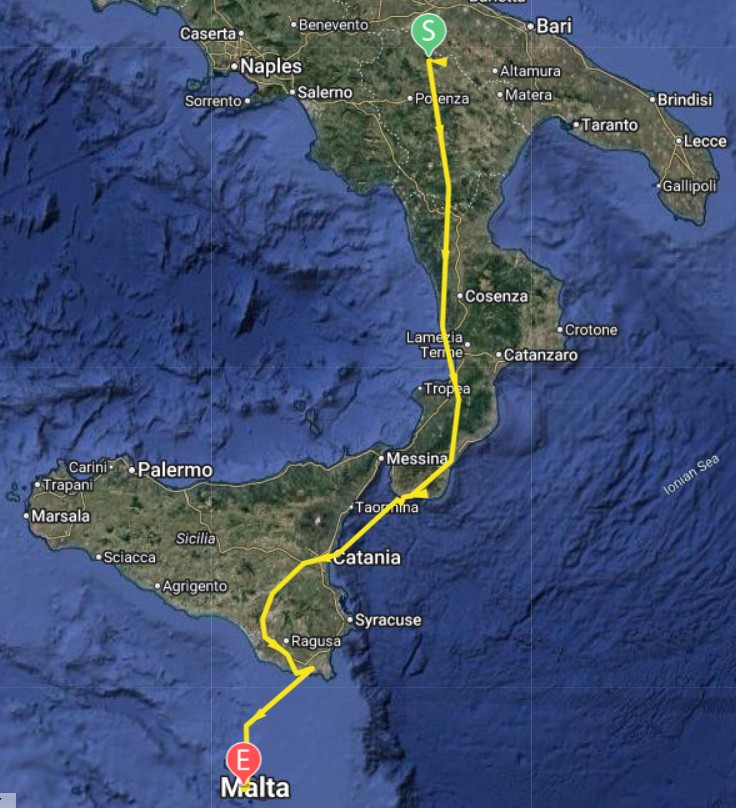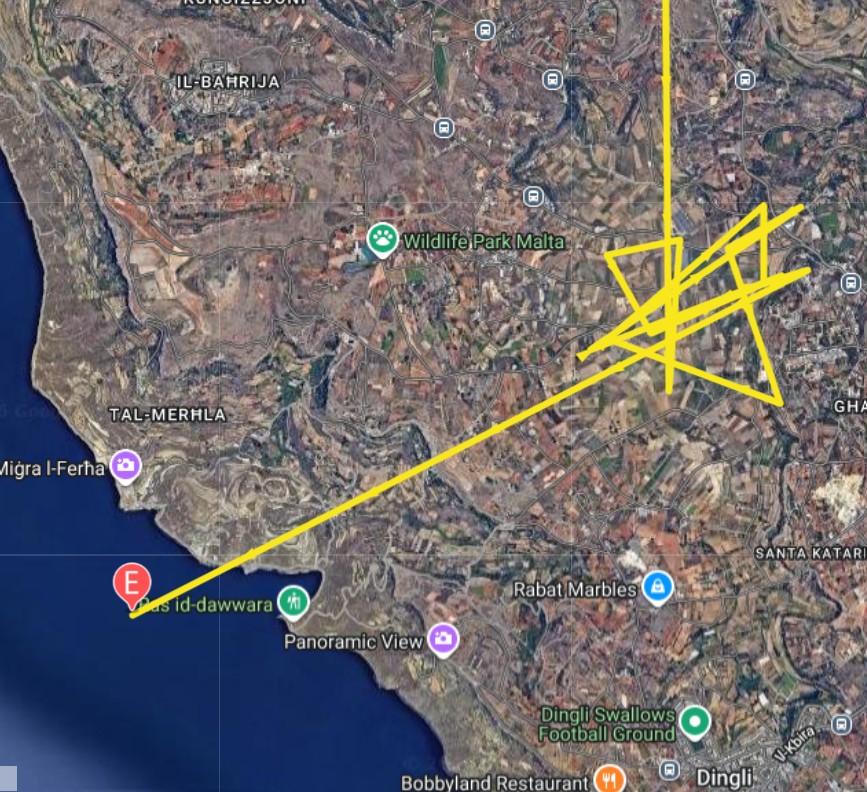
A female Common Kestrel rescued after being shot, rehabilitated and tracked across the Mediterranean has been killed just four days after returning to Malta. Her GPS transmitter recorded her final movements in the Fiddien area before her remains were tracked to the sea surface off Miġra l-Ferħa.
Named Għasri after the Gozo locality where she was rescued on 31 October 2025, the kestrel was one of four rehabilitated falcons fitted with GPS trackers under BirdLife Malta’s Wings of Hope Project, funded by the Malta Environment Foundation. She was released at Foresta 2000, Mellieħa, on 10 February 2026, following rehabilitation and veterinary care.
After spending two months in the Fiddien area, Għasri migrated to Sicily in early April before continuing to southern Italy, where she settled near Corato in Apulia. Tracking data suggested she may have nested in a rural building within an olive plantation. Following the summer in Italy, she began her autumn migration southwards, with her tracker confirming her return to Malta last Friday morning.
“This bird was given a second chance after being shot. She recovered, crossed the Mediterranean, survived the summer in Italy and found her way back to Malta. It is a brilliant testament to what our rescue and rehabilitation work can achieve,” said Nicholas Barbara, Head of Conservation at BirdLife Malta.
According to GPS data, the kestrel’s final movements on Tuesday 20 October placed her close to a trapping site and a hunting hide in the Fiddien area. At 7pm that evening, the data recorded her location at a trapping site with a body temperature indicating the bird was dead. Since her return to Malta today week, the data had shown that she was roosting in the same tree in the Fiddien area.
Her transmitter subsequently indicated that her remains had been dumped at sea off Migra l-Ferħa that evening. At 9pm on Tuesday, the transmitter recorded data from the sea beneath Miġra l-Ferħa, showing a sea temperature of 26°C and an altitude of 0 metres, indicating that it was at sea level. The Environmental Protection Unit (EPU) was briefed and carried out site investigations. The tag continued to float and transmit data for the following hours, indicating that it was still attached to the bird. Attempts to retrieve the bird from the sea were hampered by rough sea conditions. The tag stopped transmitting data, yesterday.
“To lose her just four days after she returned to Malta, after following her journey to Italy and back since February, is devastating. It clearly shows that Malta’s persistent illegal killing problem is so high that even a shot rehabilitated bird given a second chance by us, is not spared a similar second chance by others intent in decimating these birds for one reason or another. The bird was either shot and fell at the trapping site, or was killed there. When the finder discovered the bird, he panicked on seeing the protected bird fitted with a tracker, and proceeded to Migra l-Ferħa to dispose of her at sea, remarked Nicholas Barbara.
Common Kestrels are among the most frequently persecuted birds of prey in Malta, particularly during autumn migration. They are illegally shot for taxidermy or killed because they are perceived as a threat to finches used as live decoys at trapping sites. Another rehabilitated kestrel released on 10 February and tracked to the Miżieb area was also killed during the spring hunting season in April.
BirdLife Malta is appealing to anyone with information that could help identify the person responsible for killing the tagged kestrel on Tuesday evening to come forward anonymously on 79255697 or contact the EPU directly.
Għasri’s death comes during a time BirdLife Malta has repeatedly called on Prime Minister Robert Abela not to weaken penalties under the Conservation of Wild Birds Regulations, arguing that reducing the consequences of wildlife crime would benefit those who break the law. Għasri’s story is a continued testament that the illegal killing of protected birds remains a serious problem, which is not solved by reducing the penalties intended to deter it. BirdLife Malta reiteriated its appeal to Government not to proceed with amendments that weaken protection for wild birds. The organisation’s rescue, rehabilitation and tracking work demonstrates that injured birds can recover, return to the wild and contribute to Malta’s natural heritage, but their survival ultimately depends on effective protection once they are released.
Read our press release in Maltese here.